TRAVEL AT EASE

Erhai gives Dali its expansive setting. Villages at the foot of Cangshan fill that setting with smaller stories. In Zhoucheng, thread and dye determine the boundary between blue and white. In Bai three-course tea, flavour follows a particular sequence. Both offer a way into the place through the hands and the senses.
From the lake to the mountain villages
Zhoucheng belongs to Xizhou, below Cangshan’s Yunong Peak. Set between the mountain and Erhai, the village introduces another scale of Dali: a landscape shaped by making, exchange and hospitality as well as by water and sky.
From the open lakeshore to a piece of cloth, the scale of attention changes. Floral, animal and geometric patterns become part of everyday objects, giving the landscape a material counterpart in the village’s craft.
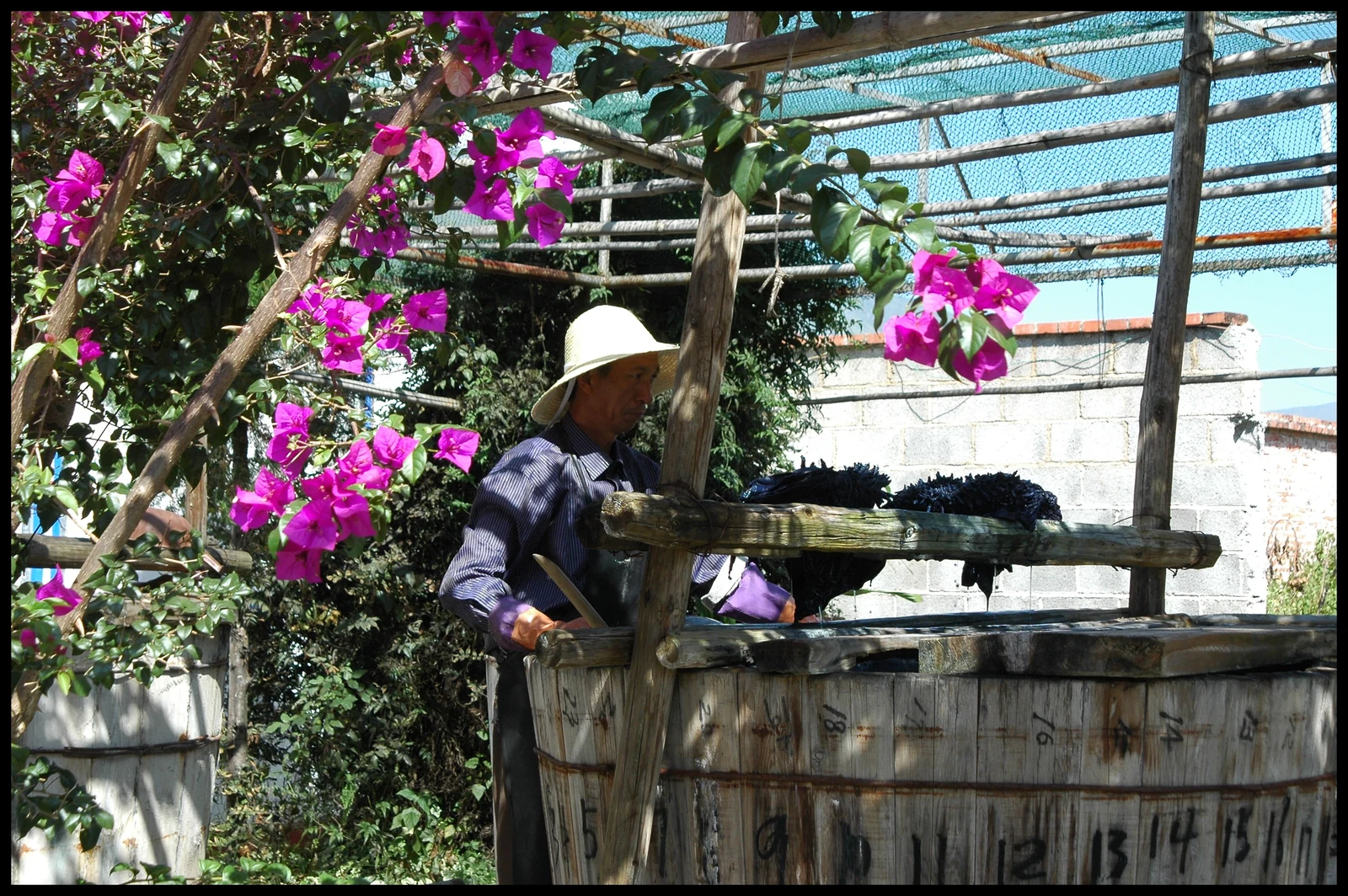
How the white pattern survives the dye
The process begins with folding, gathering and stitching. Tightly bound parts of the cloth resist the dye; the pattern becomes visible when the thread is removed. The position of each stitch and the tension of the binding help determine the white spaces.
The boundary need not be sharp. Different ties and immersions can produce a gradual halo between blue and white. That transition is part of the pleasure of examining the cloth. Its colour alone does not tell you whether a contemporary maker has used plant indigo or another dye.
Bitter, sweet, then lingering
Bai three-course tea is a tradition of hospitality centred on Dali. For the first, bitter course, leaves are roasted in a warmed pot before water is added. The sweet course can include walnuts and brown sugar. Honey, Sichuan pepper and cinnamon bring further layers to the final cup.
Details vary, but the sequence has a meaning beyond ingredients. The three flavours invite a conversation about experience: difficulty, sweetness and reflection. It is a social tradition with its own setting, rather than a recipe detached from the people serving it.
Flavour as a form of welcome
Roasting, nuts and aromatic spices give the three cups different textures and finishes. If you have an opportunity to taste them, the particular household’s way of preparing the tea is part of the story.
Look for the edge of the blue
On a piece of tied-and-dyed cloth, find the white pattern, the blue field and the halo between them. This shifting boundary reveals the work of stitching and dye more clearly than perfect symmetry could.
Erhai supplies the broad view; thread and tea give that view an intimate scale.
Sources and photography
Yubing Zhang / Unsplash · Photo source · Unsplash License
Richard Weil / Wikimedia Commons · CC BY-SA 2.0 · resized, WebP · Photo source · CC BY-SA 2.0