TRAVEL AT EASE
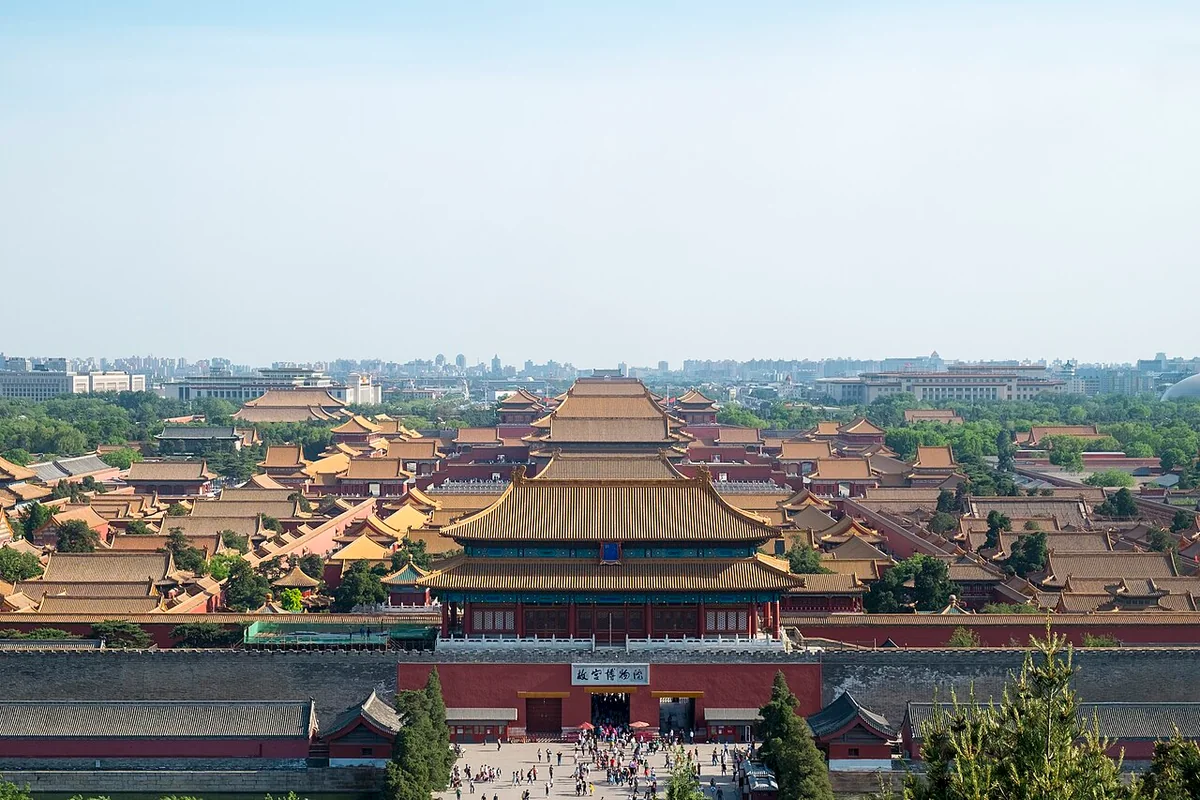
From Jingshan, golden roofs rise one behind another, with the present-day city beyond. It is an easy view in which to remember Beijing’s grandeur. A hutong offers another scale: the space between doors, a strip of shade beside a wall, and the capital’s story brought closer to ordinary life.
An axis is a relationship between places
The Central Axis is more than a straight line joining famous buildings. Palaces, gardens, ritual spaces and public buildings express an idea of a capital through their arrangement. Its origins lie in the Yuan dynasty, with later development under the Ming and Qing. Beijing was not built all at once, and “old” should not be read as “unchanged”.
The Forbidden City has its own sequence. The Outer Court and Inner Court distinguish ceremonial space from residential life through gates, courts and halls. Notice the open spaces as well as the buildings. One courtyard holds you at a distance; a doorway narrows the view. The effect of ceremony comes partly from the space you cross before reaching a hall, not simply its height.
The hutong brings the city to the doorstep
Beyond the palace scale, read the street differently. The neighbourhood pattern around Nanluoguxiang can be traced to the Yuan dynasty. A main lane and side alleys offer clues to its urban structure. History here is not confined to famous former residences: the connection between street and courtyard matters too. An inherited layout does not mean every house retains an equally old appearance.
From a public lane, notice how a courtyard entrance separates the road from domestic space. A screen wall or turn may reveal less than an open view, yet invite closer attention. Deliveries, residents coming and going, and everyday conversations are not performances arranged for visitors. Keep doorways clear when taking photographs. Enter only an identified public space or with the occupant’s permission.
Roofscape and street view tell different stories
The photograph on this page looks south from Jingshan over the Forbidden City. Shenwumen is in the foreground; successive palace roofs and more distant city buildings share the frame. Looking south from this northern viewpoint, your gaze passes the Inner Court before reaching the ceremonial Outer Court. Look at the gaps between major halls and the lower roofs to either side: symmetry becomes a relationship you can see.
At street level, a roof may appear only in fragments, interrupted by walls or trees. That incompleteness has its own interest. From above, you grasp an arrangement; nearby, you notice a threshold, shade and a change of direction. Bring the two views together and Beijing becomes more than the palace façade: it has inherited planning, continuing conservation and contemporary life.
Zhajiangmian returns the story to the table
Noodles, bean sauce and vegetable accompaniments make an everyday bowl. Rich sauce and crisp vegetables change their balance as you mix them, leaving room for personal preference. It is a small counterpoint to the capital’s grand narrative; ingredients and portions depend on the kitchen in front of you.
Notice both sides of a doorway
From a public street, look at how an eave, doorframe and turn control the view. You can begin to understand the boundary between lane and home without entering a private courtyard.
Beijing rewards a broad view, and a quieter moment at a doorway.
Sources and photography
UNESCO · Beijing Central Axis ↗
Windmemories / Wikimedia Commons · Photo source · CC BY-SA 4.0