TRAVEL AT EASE
A library offers a way into Tengchong. Why did a mountain town build a shared space for reading, and how did people overseas maintain a connection with home? From Heshun’s books and courtyards to volcanic landforms and hot springs, both cultural exchange and the changing earth leave traces to explore.
Bringing books back home
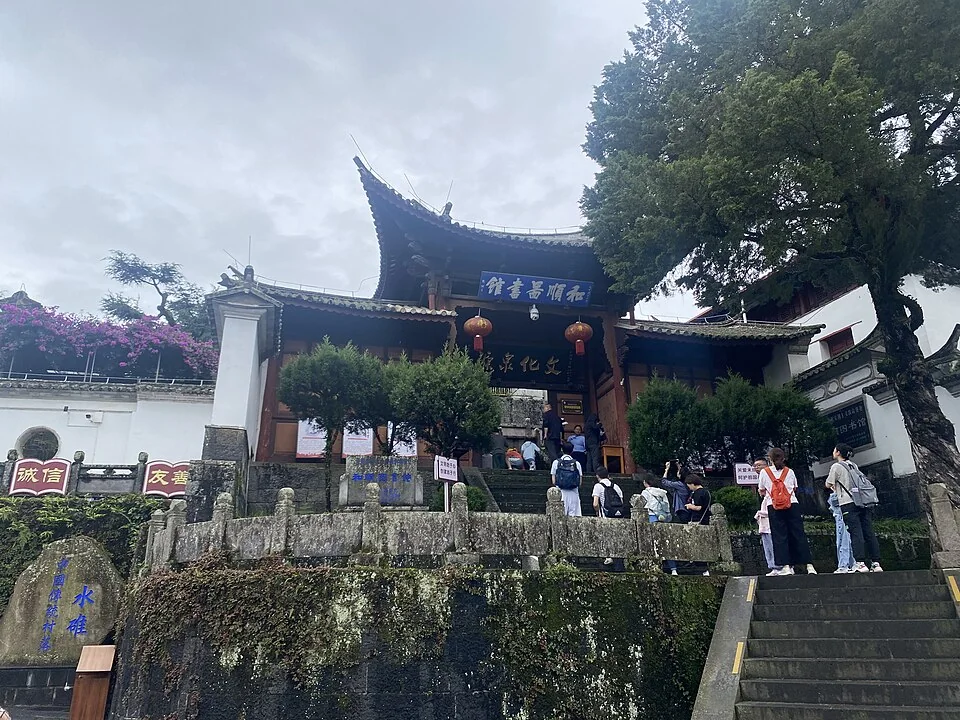
Chinese emigrants in Burma funded Heshun Library in 1928, following an earlier reading society established in 1924. This gives the idea of an emigrant hometown a tangible form. Connections with home could continue through education, reading and shared cultural resources, as well as through a personal return.
Read the building’s introduction, then notice how a courtyard leads you in and how doors and windows connect inside and out. Bookshelves and reading seats deserve attention alongside the eaves. The donors’ contribution ultimately created somewhere for people to read, rather than simply a handsome inscription to photograph.
An old building with a present purpose
The library building completed in 1938 has a five-bay main block and combines Chinese and Western architectural elements. Look first at proportion, entrance and courtyard, then consult the account of that particular building. This helps distinguish documented exchanges from whatever a visitor might imagine every old window represents.
It remains a place for quiet reading. Heshun’s current visiting notice prohibits amplified guiding and directs group introductions outdoors. Livestreaming and portrait shoots that disrupt reading are prohibited in the borrowing room. Check current access arrangements, lower your voice and keep circulation clear so that visiting and everyday use can coexist.
Volcanic forms and geothermal change
Tengchong offers two scales of geological observation. Volcanic cones, lava plateaus and basalt columns preserve landforms created by geological activity. At Rehai, hot springs, steam vents and mineral deposits reveal geothermal energy at the surface. Rising vapour is not flowing lava; these are different phenomena to understand.
On a hillside, follow silhouette and slope. At a thermal feature, notice the relationship between water, rock and deposited edges, staying within open paths, barriers and safety instructions. Connect the shape of a whole hill with the texture of volcanic rock at a closer scale. The landscape becomes readable from outline to detail.
Rice, sliced or cut into strands
Dajiujia uses sliced erkuai rice cakes for stir-frying; ersi are thin rice strands served in preparations including soup. Ask about ingredients and preparation, and notice how shape and cooking change the texture.
Leave room for quiet
Read some history outdoors before entering the library. Inside, attend to the building and its readers. Consider why people living abroad wanted to support this place: the town’s connections become much more concrete.
Books brought the wider world home. Volcanic forms and hot springs draw the eye towards the earth. Tengchong rewards both kinds of attention.
Sources and photography
Windmemories / Wikimedia Commons · Photo source · CC BY-SA 4.0
瑞丽江的河水 / Wikimedia Commons · Photo source · CC BY-SA 4.0